Support for Research and Development Activities and Accounting Practices under Law No. 5746
Support for Research and Development Activities and Accounting Practices under Law No. 5746

The purpose is to support and encourage, through R&D, Innovation, and Design, the production of technological knowledge, innovation in products and production processes, the improvement of product quality and standards, increased productivity, the reduction of production costs, the commercialization of technological knowledge, the development of pre-competitive collaborations, technology-intensive production and entrepreneurship, the acceleration of the inflow of investments into these fields into the country, and the increased employment of R&D and Design Personnel and a Qualified Workforce, so that the national economy attains a structure capable of competing at the international level.
From the definition above, we can see how the framework of Law No. 5746 is actually drawn. In addition, the deductions and supports provided are set out in Article 3 of the same law. Let us explain them item by item: in terms of SGK (Social Security Institution) premiums; in terms of Income Tax and Stamp Duty arising from wage payments; in terms of KDV (VAT) and Customs Duty arising from machinery and equipment purchases; in terms of Stamp Duty exemptions in contracts to be concluded with TEKMER and Technopark companies within the ecosystem as well as with various public institutions, KOSGEB, TÜBİTAK, and similar organizations; and in terms of tax base deductions for Income Tax and/or Corporate Tax.
In Terms of SGK (Social Security Institution):
Companies within Technoparks and TEKMERs can benefit from the reduction under Law No. 5746, provided they have no outstanding SGK debt. Without the reduction, the SGK contribution rate is 37.75%. When we deduct the unemployment insurance premiums, it comes to 34.75%. The employee's SGK share is 14%, which leaves 20.75%. In general, employers are granted a 4% reduction under Law No. 5510. Half of the remaining amount — that is, half of 16.75% — equals 8.375%. In total, a reduction of 12.375% is obtained from SGK.
For example, suppose the SGK premium base (SPEK) for the relevant period is TRY 400,000. The SGK accrual would be as follows:
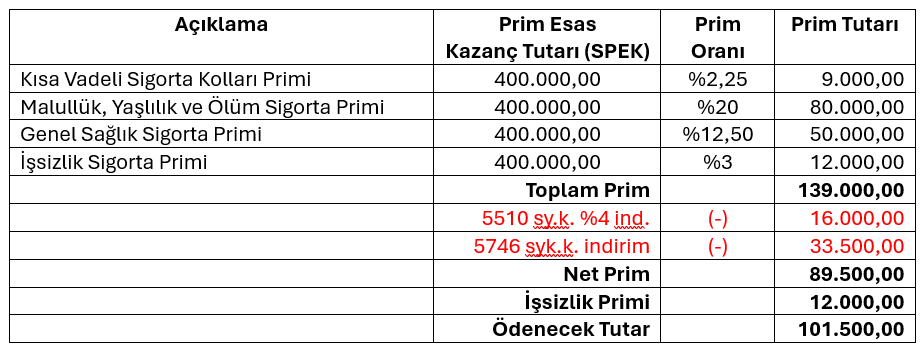
To benefit from this reduction, there must be no outstanding SGK debt. Furthermore, since the Social Security Support Premium (SGDP) is paid for retired employees and no reduction can be obtained for it, the reduction under Law No. 5746 cannot be applied to them.
In addition, another matter that requires attention is overtime. As can be seen when both Law No. 4691 and Law No. 5746 are examined, overtime payments — even though they are included in the gross wage — have been excluded from the scope of Law No. 5746. In this case, since they appear under the Bonus section of the SGK Service List, the SGK reduction cannot be applied to them. So, are the premium, heating, meal, transportation, additional payment, technology allowance, electricity allowance, and other fringe benefit payments found in the same section — the bonuses section — also outside the scope? No. In the numerous rulings issued by the Ministry of Finance on this matter, the relevant fringe benefits are added to the gross wage and designated as the grossed-up wage. By this means, the SGK reductions can also be used for them.
In Terms of Income Tax and Stamp Duty Arising from Wage Payments:
The actual, hands-on work of personnel employed within Technoparks and TEKMERs is indispensable. In addition, under today's conditions, hybrid working models entered our lives before the pandemic period and have become increasingly widespread. Under the applicable legislation, remote working can be utilized on a 100% full-time basis until 31.12.2028. When uploading payrolls with the Withholding Tax Return, the notification can be made as remote work. For the relevant personnel, all fringe benefit payments in the gross wage — alongside their base entitlement, excluding overtime and the income tax arising from notice pay — are subject to the Income Tax Exemption. While the write-off is 100% in Technoparks, in TEKMERs it varies according to education levels.
The relevant provision of the law states: holders of a PhD are subject to a reduction of 95%, holders of a Master's degree 90%, and holders of a Bachelor's degree, Associate degree, Vocational High School diploma, or Vocational Qualification Certificate 80%.
For example, suppose Ahmet Mehmetoğlu, a graduate of a Faculty of Engineering, has a gross salary of TRY 100,000; his income tax base would then be TRY 85,000.00. Assuming an income tax rate of 20%, this amounts to TRY 17,000. There is TRY 3,315 of income tax support arising from the minimum wage. The remaining net income tax comes to TRY 13,685. In this case, there is an 80% withholding tax support under the project: TRY 10,948. The net withholding tax remaining after the reduction is TRY 2,737.
So, what about the stamp duty arising from the wage? It falls entirely within the scope of the exemption. Let us again proceed from the example above. As you know, the stamp duty arising from wages is levied at a rate of 0.759%. It is calculated on the gross wage. Based on a gross wage of TRY 100,000, it amounts to TRY 759. The stamp duty arising from the minimum wage is TRY 197. The remaining TRY 562 is written off directly under the exemption.
There are a few more important details here. One of them is that the fact that a retired employee subject to SGDP cannot benefit from any SGK reduction does not mean that they cannot benefit from the Income Tax and Stamp Duty reductions. Therefore, depending on their level of education, retired personnel working within the project also benefit from the reductions under Law No. 5746.
Another point is payments made as attendance fees (huzur hakkı). In fact, business owners who work within the project and actively take part in it are covered by Bağ-Kur (the social security scheme for the self-employed). Although recorded as an attendance fee, it is treated as an employee payment. However, it is reported under code 014, not 012, on the Withholding Tax Return. Apart from that, the reductions and write-offs are applied to the income tax arising from the calculated wage under exactly the same conditions as those described above.
In Terms of VAT and Customs Duty Arising from Machinery and Equipment Purchases:
Another opportunity offered to Technoparks and Technology Centers, i.e., TEKMERs, is an exemption from Value Added Tax (VAT) for the products to be used in the project and to be purchased, both on their importation and on procurements from the domestic market.
The application to be made in this regard is quite similar to Investment Incentive Certificate applications, if you have filed one before. You connect via the Digital Tax Office, through the former Internet Tax Office. There is a VAT Refund Transactions section there, and further down you will find VAT Exemption Certificate Transactions. On the screen that appears, a drop-down menu opens in the VAT Exemption Certificate Type field, where you will find the section "27 - Exemption for Deliveries of New Machinery and Equipment to Be Used in R&D, Innovation, and Design Activities." There, you fill in the name of your activity, the start date of the project, the delivery date of the machinery and equipment, and the cost, and save; the system then automatically completes the petitions and forwards them to your file officer at your tax office. You will carry out the subsequent process in contact with your officer, and the relevant letter will be issued within approximately one month, if the application is found appropriate. With a copy of this letter, you will be able to purchase the machinery you wish to buy exempt from VAT. Likewise, if you are going to import the machinery and equipment in question, after obtaining this letter the bill of lading should be issued and the shipment from abroad should commence accordingly; your customs broker will then submit this letter to the Ministry of Customs via the Single Window System, and on the basis of this letter — since you are a Technopark or TEKMER company — you will neither pay VAT at customs on the purchase/import transaction nor be liable for the Customs Duty arising on this import, from which you will be exempt. The point to note here is that while you are exempt from customs duty, additional customs duties introduced subsequently are not covered by this exemption.
Now, if a question comes up such as, "Software companies in Technoparks issue invoices without VAT — can we do the same in a TEKMER?", our answer can be stated very firmly: "According to the legislation enacted up to 30.03.2025, there is no VAT exemption on sales in TEKMERs." Although these institutions, governed by two separate laws, generally have similar provisions in many areas, they diverge very sharply on certain points. This was one of them.
Exemption from Stamp Duty Arising from Contracts:
By their very nature, Technoparks and Technology Centers, i.e., TEKMERs (which may come to be referred to as Informatics Offices in the days ahead), form an ecosystem. Within this ecosystem, by the very nature of commerce, companies will interact with one another and enter into commercial alliances, partnerships, or solution partnerships. At this point, the system exempts contracts concluded between companies within a TEKMER from stamp duty. Likewise, if a TEKMER company concludes a contract with a Technopark company and a monetary amount is stated in the contract, it is excluded from the scope of stamp duty even though it would normally be subject to it. And if you ask what the obligations of such a Technopark or TEKMER company are with respect to contracts concluded with companies outside these zones, i.e., with other commercial companies, those obligations continue unchanged, and such contracts will be subject to stamp duty.
Income or Corporate Tax Deduction under Law No. 5746:
This is exactly where TEKMERs and Technoparks diverge sharply. While Technoparks enjoy an earnings exemption, TEKMERs are entitled to a deduction from the tax base. To put it in simple terms: in a Technopark, after deducting your costs from your income, you can directly write off the resulting commercial profit and be exempt from tax. We can make this interpretation assuming you have no ancillary income. For example, you received your project completion letter and completed your project. At the end of the day, you sold your project, which cost TRY 3 million, for TRY 25 million. Your earnings under the project amount to TRY 22 million, and this amount is exempt from tax. The tax arising is written off directly. There is no need to submit a separate report for this, and there is no Sworn-in Certified Public Accountant (YMM) requirement.
So, what would happen if this were within a TEKMER? Naturally, the process works differently, because here there is no exemption from Corporate Tax or Income Tax — there is a deduction. And where there is a deduction, the report must be certified by a Sworn-in Certified Public Accountant (YMM) by the end of June of the relevant year.
For example, suppose you have an ordinary, ongoing business: you earned TRY 10 million in revenue from the project, and your other commercial revenues amount to TRY 15 million. Your costs incurred during the year total approximately TRY 22 million. If this company were not in a TEKMER and had no project, the corporate tax it would pay (25 - 22 = TRY 3 million tax base) would be TRY 750 thousand. So what would the situation be in a TEKMER? Your project is completed, and you have transferred your expenditures to account 750. Suppose that against your TRY 10 million of R&D revenue, you incurred TRY 9 million in costs. We remove this amount from expenses and capitalize it in account 263. Automatically, your cost in the income statement would become (22 - 9) TRY 13 million. Against TRY 25 million of revenue, the commercial profit in the income statement would be TRY 12 million. Wait a minute — although it may seem that a higher profit has emerged and more tax will be paid, by adding the TRY 9 million R&D cost directly to the "deductions allowable even in case of loss" column on the tax return, you bring your profit/loss back to the same amount. This time, however, you have an Intangible Fixed Asset worth TRY 9 million on your balance sheet, representing know-how. Your balance sheet improves considerably in terms of ratios and values.
All these details vary according to companies' projects, the ecosystem and conditions they operate in, and the progress of their projects. In the examples above, we have tried to explain the subject in the plainest possible terms.
We hope you find this useful,
Our accountants can review your specific situation and guide you on the next step.
Request a Meeting