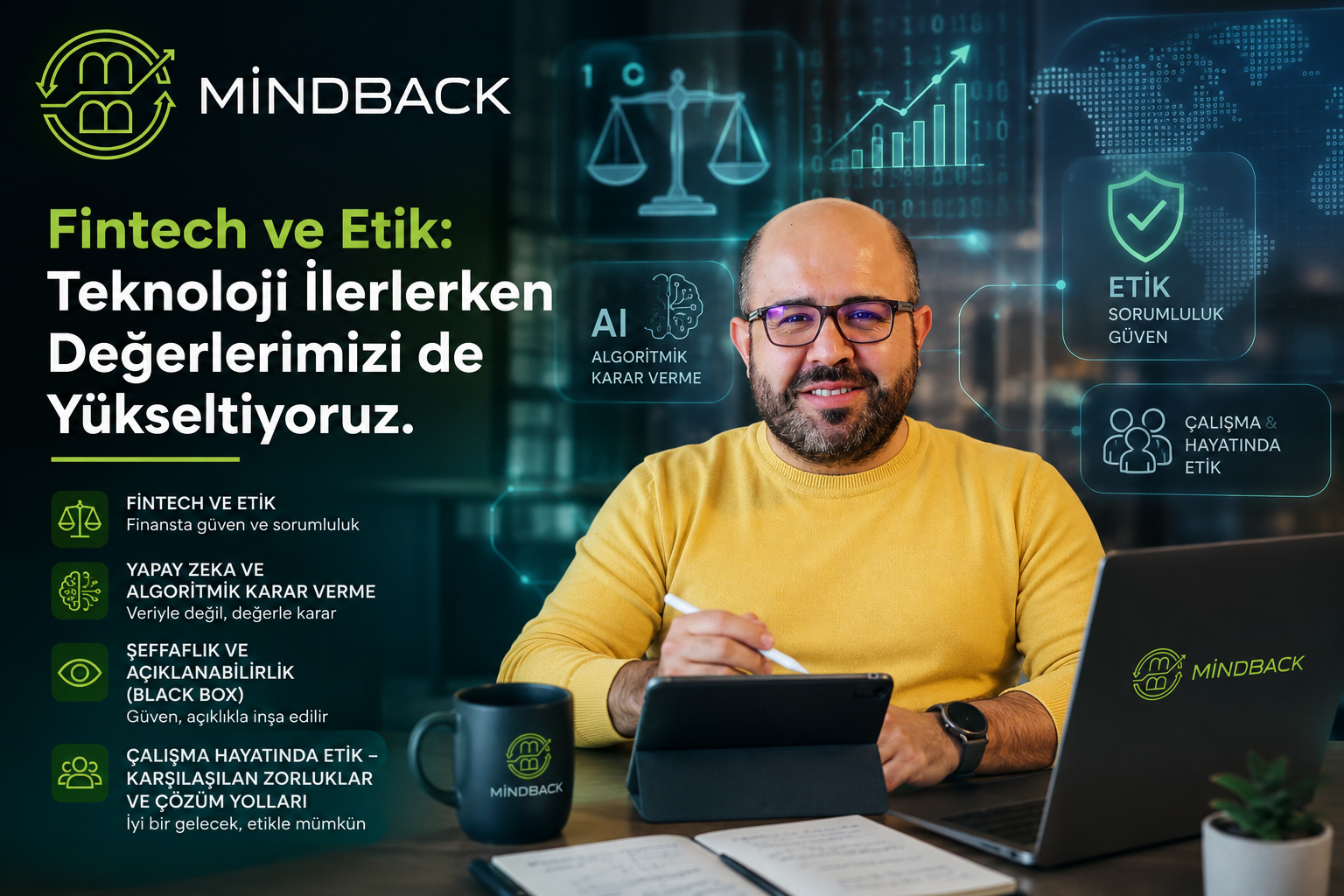
The Architecture of Trust in the Digital Age: Ethics in Accounting and the Future Vision of the Profession
Introduction: Why Is Ethics So Important in Accounting?
In this article, we will try to explain why ethics in particular matters so much, while also sharing our own perspective throughout the sections.
An investor often makes a multimillion-lira investment decision based on nothing more than a few pages of financial statements. A bank relies on companies' financial data when setting credit limits. The state builds its tax policies and audit processes on financial reports. Employees, in turn, judge their company's future through those very same statements. But what if this information does not reflect reality? This is exactly where ethics comes into play. The accounting profession is not merely a technical activity of keeping records or preparing tax returns. It is also one of the most important professions forming the trust mechanism of the economic system. Every balance sheet, every income statement, and every financial report prepared directly affects the decision-making processes of investors, credit institutions, public authorities, and the business world. For this reason, ethics in accounting does not simply mean complying with legislation; it means generating trust, preserving transparency, and safeguarding the public interest.
Financial history has shown time and again that conduct contrary to ethical principles can affect not only the companies involved, but millions of people and even entire national economies. Events such as Enron, WorldCom, and the 2008 Global Financial Crisis are the most concrete examples of how seemingly minor ethical violations in financial reporting can produce global consequences. Today, the accounting profession stands on the threshold of a new era. Artificial intelligence, big data analytics, automation, blockchain, and FINTECH applications are fundamentally transforming the world of finance. It is no longer just the accuracy of financial information that matters; how the algorithms producing that information work, what data they were trained on, and what criteria they use to make their decisions are now also at the center of the ethical debate. The accountant of the future will not simply be someone who knows the legislation. They will be a professional who uses technology properly, questions algorithms, ensures data security, and never fully surrenders their professional judgment to a piece of software. Ethics therefore remains the cornerstone of the profession today, just as it was in the past; but in the age of digital transformation, it has taken on a far broader meaning.
🟢 The Mindback Perspective
Technology advances with every passing day. Accounting software is getting smarter, artificial intelligence can complete financial analyses within seconds, and automation is taking over many routine tasks. Yet no technology can generate trust. Trust is created by the human being who interprets the information, questions it, and carries the final responsibility. In our view, the successful accountant of the future is not the one who uses artificial intelligence the most, but the one who manages it the best.
________________________________________
Section 1: Fundamental Ethical Principles in Accounting and Finance
Ethical values are as central to the accounting profession as technical knowledge. The accuracy of financial statements depends not only on their being prepared in accordance with accounting standards, but also on the ethical approach of the professional who prepares them.
The International Federation of Accountants (IFAC), the IESBA Code of Ethics, and the professional ethics principles adopted by TÜRMOB (the Union of Chambers of Certified Public Accountants of Turkey) constitute the shared values of the accounting profession across the world.
These principles are not merely theoretical rules. They form the basis of every decision made in daily professional life.
1. Integrity
Integrity is the indispensable principle of the accounting profession. A financial advisor or accounting professional may never knowingly distort the truth, provide misleading information, or be party to fraud in any way while preparing financial reports, filing tax returns, or providing advisory services. Yet integrity is about more than not lying. Not withholding information, not concealing material risks, and ensuring that financial statements fully reflect reality are also inseparable parts of integrity. This principle lies at the heart of the trust that investors, banks, and public institutions place in the accounting profession today.
2. Objectivity
One of a professional's most valuable assets is the capacity for independent judgment. Pressure from a client, a commercial relationship, family ties, financial interest, or the fear of losing business must never influence professional judgment. Particularly in independent audit engagements, any erosion of the principle of objectivity can produce consequences that affect not only the company concerned but the capital markets as a whole. Objectivity is, more often than not, the courage to say "no."
3. Professional Competence and Due Care
Tax legislation, accounting standards, financial reporting rules, and technology are changing constantly. A professional therefore cannot be content with holding a diploma. They must keep learning, keep developing, and follow current developments closely. Especially today, as AI-supported accounting software becomes widespread, professional competence is no longer just a matter of knowing the legislation. Data analytics, digital security, AI literacy, and technological transformation have also become a natural part of professional development.
4. Confidentiality
Accounting is one of the professions entrusted with the most sensitive commercial information. Companies' financial statements, salary data, investment plans, tax strategies, and trade secrets are protected not only by law but also by ethics. With digitalization, the concept of confidentiality has gained a new dimension. Locking the filing cabinets is no longer enough. Cloud systems, artificial intelligence platforms, email traffic, remote working applications, and mobile devices are now integral parts of data security.
Protecting data is no longer merely a technical requirement; it is a professional ethical responsibility.
5. Professional Behavior
A professional is obliged not only to do the work correctly, but also to protect the reputation of the profession. Complying with legal regulations, showing respect to colleagues, avoiding unfair competition, and refraining from conduct that could undermine public trust form the foundation of this principle. In the digital age in particular, social media posts, advertising activities, and digital visibility also fall within the scope of professional behavior. Unethical practices aimed at winning clients in the short term damage both individual reputation and the credibility of the profession in the long run.
🟢 The Mindback Perspective
The moments when ethical rules are tested hardest are not those where the legislation is clear, but those where the gray areas begin. Many decisions may be technically possible. But not every technically possible decision is ethically right. In our view, what sets a good accountant apart is not simply knowing the legislation; it is being able to make the right decision even under pressure. Because the most valuable capital earned over a professional lifetime is not knowledge, but trust.
________________________________________
Section 2: Ethics in Communication — The Invisible Force That Builds Trust
In the accounting and finance profession, communication is about far more than transmitting information. A financial statement that is prepared, an email that is sent, a client meeting that is held, or an opinion given verbally will often directly influence people's major financial decisions. Ethics in communication is therefore as important as professional knowledge. A single poorly worded sentence, a piece of information shared incompletely, or a notification not made on time can lead both to financial losses and to damage to the relationship of trust.
Ethical communication means protecting accuracy, transparency, respect, and confidentiality all at the same time.
Accuracy and Transparency
In the accounting profession, giving accurate information is not enough. Conveying information completely, on time, and in a way that leaves no room for misunderstanding is also part of the ethical responsibility. When preparing financial reports, advising clients, or presenting to investors, portraying the data as more positive or more negative than it really is is ethically unacceptable. The practices known in the literature as "Creative Accounting" typically seek to present financial reality as something other than it is by exploiting gaps the law does not explicitly prohibit. Even where some of these practices appear technically compliant with the legislation, any approach aimed at concealing the truth is incompatible with ethical principles. Transparency is not merely telling the truth; it is being able to tell the whole truth.
Active Listening and Respect
A good accountant is not merely a good talker. They are also a good listener. Advice given without understanding the client's needs, even when technically correct, often fails to land in practice. Likewise, listening without prejudice to employees' concerns, audit teams' findings, or managers' expectations leads to sounder decisions. Ethical communication requires trying to understand the other party before trying to persuade them. Professional respect means being open not only to colleagues, but also to different views and to criticism.
Protecting Confidentiality
Confidentiality is one of the most important elements of trust in the accounting profession. Professionals have access to extremely sensitive information such as companies' financial statements, investment plans, personnel salaries, commercial contracts, and strategic decisions. Sharing this information with unauthorized persons is not only unlawful; it is also a serious ethical violation. Today, the risk is no longer confined to the office environment. Social media posts, online meetings, collaboration platforms, and even everyday conversations can lead to unintended information leaks. "I didn't mention any names." is often not enough. Sometimes even a few small details can make the company or person concerned easily identifiable.
Ethics in Digital Communication
While digitalization has accelerated communication, it has also brought new ethical responsibilities with it. Today, a significant portion of accounting processes is carried out through;
• email,
• cloud systems,
• electronic document management,
• online meetings,
• instant messaging applications
• and AI-supported platforms.
Consequently, strong passwords, multi-factor authentication, access management, and secure data sharing have become the ethical responsibility not just of IT teams, but of every accounting professional. With the spread of artificial intelligence tools in particular, yet another issue requiring attention has emerged. Uploading companies' confidential financial data, without control, to AI platforms when it is not known in which country the data is processed or how it is stored may create significant legal and ethical risks in the future. Using technology securely is just as much an inseparable part of ethical conduct as using it at all.
🟢 The Mindback Perspective
In the digital age, communication no longer takes place only between people. Communication between humans and artificial intelligence systems has also become part of the profession. An accountant must know where the data they send to an AI system is processed, how it is stored, and whether it is shared with third parties. In the future, an accountant without data security knowledge will carry as much risk as an accountant with gaps in financial reporting knowledge.
________________________________________
Section 3: Ethics in Working Life — Challenges Encountered and Ways to Address Them
Knowing ethical principles is important. But the real test of professional life comes at the moments when those principles have to be applied under pressure. Accounting professionals often have to contend not only with legislation, but also with client expectations, management pressure, commercial concerns, and time pressure. This is exactly where ethics ceases to be theory and moves to the center of everyday decisions.
1. Management Pressure
One of the most common ethical dilemmas accountants face is management pressure. Requests to shift revenue into a different period, defer expenses, conceal losses, or make the financial statements look more favorable to investors are not merely technical accounting problems. Such requests directly contravene the principles of integrity and objectivity. Seemingly small adjustments made for short-term commercial gain can irreparably damage the reputation of both the company and the professional in the long run.
2. Conflicts of Interest
Ethical risk arises where a professional's personal interests conflict with those of the client, the investor, or the public interest.
For example;
• becoming a business partner of a client,
• obtaining a financial interest,
• taking on roles in companies managed by family members,
• being unable to decide objectively because of a performance bonus
situations like these can impair professional judgment.
In such cases, the soundest approach is to disclose the conflict of interest transparently and, where necessary, to decline the engagement.
3. Gifts and Benefits
In professional life, the line between courtesy and a relationship of interest can sometimes be very thin. While token gifts are considered reasonable by most organizations, high-value gifts, holidays, or offers of personal benefit can threaten independence. The key question here is this: "Would my accepting this gift cause a reasonable outside observer to doubt my objectivity?" If the answer is "yes," the ethically correct approach is to decline the gift.
4. Unfair Competition
Professional ethics involves responsibility not only toward clients, but also toward colleagues. Making unrealistic promises, disparaging competing professionals, distorting the market with unsustainable pricing policies, or sharing misleading success stories on social media may seem to bring a short-term advantage, but in the long run they damage the standing of the profession. A strong brand is built not on unethical competition, but on knowledge, trust, and sustainable service quality.
The Ethical Decision-Making Process
Ethical dilemmas are rarely as clear-cut as black and white. The conceptual framework developed by the IESBA therefore offers professionals a systematic method of evaluation.
1. Identify the Threat
Identify the threats that could influence your decision;
• self-interest,
• intimidation,
• familiarity,
• advocacy
• or self-review.
2. Assess the Situation Objectively
Ask yourself this question: "If an independent and informed third party were to evaluate this decision, would they conclude that I acted in accordance with ethical principles?" This question often makes it easier to find the right answer.
3. Take the Necessary Safeguards
If the risk can be eliminated, apply the necessary control mechanisms.
If it cannot;
• declining the engagement,
• notifying management in writing,
• obtaining an independent opinion
• or withdrawing from the file
may be the most appropriate solution.
🟢 The Mindback Perspective
Ethical decisions are rarely made on matters where the law provides a clear answer. The real test begins in the gray areas. A decision may be legal. Yet that same decision may damage your company's reputation. In our view, a good accountant does not only ask, "Is it legally permissible?" They also ask this question: "If I look back on this decision five years from now, will I still be able to defend it with the same ease?"
________________________________________
Section 4: Lessons from History — The Real Cost of Ethical Violations
Ethical rules are often perceived as abstract concepts. Yet financial history has shown us time and again that ethical violations are never just a handful of accounting entries. A single misprepared financial statement, a small irregularity that is overlooked, or one wrong decision made under management pressure can affect not just one company, but thousands of employees, investors, and even national economies. Behind many of the ethical rules taught in accounting courses today lie major crises that actually happened. History, therefore, does not merely recount the past. It also points to the mistakes that must not be repeated in the future.
Enron and Arthur Andersen: Trust Can Be Lost in a Day (2001)
By 2001, Enron was regarded as one of the largest energy companies in the United States. The company was an investor favorite. Its share price kept rising, and its financial statements looked strong. But the picture on display did not reflect reality. Enron was keeping billions of dollars of debt off its balance sheet through Special Purpose Entities (SPEs), presenting investors with a financial structure far stronger than it actually was. Throughout this period, Arthur Andersen, one of the largest audit firms in the world, signed off on Enron's financial statements. After the company went bankrupt, it emerged that a significant portion of the audit documents had been destroyed. The outcome was not just Enron's collapse. Arthur Andersen, which had some 85,000 employees, lost its professional reputation entirely and was forced to wind down its operations. The global audit sector once known as the "Big Five" thus became the "Big Four."
The Lesson from This Case: The commercial relationship between auditor and client must never take precedence over independence. An audit firm's greatest asset is not its client portfolio, but its credibility. And once trust is lost, even the largest institutions may not survive.
WorldCom: "I Was Just Following Orders" Is Not a Defense (2002)
Barely a year had passed since the Enron scandal. This time, WorldCom, one of the world's largest telecommunications companies, made headlines with a similar ethical crisis. The company's management recorded approximately 3.8 billion dollars of operating expenses as capital expenditure, making its financial statements appear more profitable than they were. Subsequent investigations revealed that the true figure exceeded 11 billion dollars. The company went bankrupt. Its executives were prosecuted. But the impact did not stop there. To restore investor confidence, the US Congress enacted the Sarbanes-Oxley Act (SOX). This legislation is still regarded today as one of the world's most important corporate governance laws.
The Lesson from This Case: Working under management pressure does not remove ethical responsibility. An accountant or finance professional is also personally responsible for the accuracy of the financial statements they prepare. "That is what management wanted." is not a valid ethical defense.
The Horizon Scandal: Artificial Intelligence and Software Are Not Infallible
As technology evolves, ethical problems change too. The Fujitsu Horizon system used in the United Kingdom is one of the most striking examples. For years, system-generated errors appeared in the accounts of Post Office workers. But because of excessive trust in the software, these errors were assumed to be caused by the users. As a result, more than 900 postal workers were wrongly accused of theft. Some were convicted. Some lost their jobs. For some, life changed forever. Investigations conducted years later revealed that most of the problems originated in the software. This was not merely a software failure. It was a historic example of the enormous consequences that can follow when human oversight is pushed into the background in favor of technology.
The Lesson from This Case: No algorithm is beyond question. No software produces absolute truth. Professional skepticism will remain one of the accountant's most important competencies in the age of artificial intelligence as well.
Volkswagen: When Technology Is Used for Unethical Ends
The Volkswagen emissions scandal that shook the automotive industry in 2015 went down in history as one of the most significant examples of technology being used for unethical purposes. Through software installed in its diesel vehicles, the company produced one set of results during emissions tests and entirely different results in real-world use. Vehicles that appeared environmentally friendly under test conditions emitted dozens of times above the permitted limits in normal use. Volkswagen ultimately faced billions of dollars in fines. But the greatest loss was not financial; it was reputational.
The Lesson from This Case: Technology is not ethical in itself. It is human decisions that make technology ethical or unethical. The engineers who develop the software, the accountants, the managers, and the auditors all share the same ethical responsibility.
🟢 The Mindback Perspective
When we examine the great scandals of the past, one common thread stands out. The problem was never just the accounting entries. The problem was;
• wrong decisions made under pressure,
• management demands that went unquestioned,
• the mindset of "No one will notice."
• and the treatment of technology as absolute truth.
Today, in the age of artificial intelligence, the same risk persists. Algorithms may change. Software may improve. But the capacity for ethical judgment is still a human responsibility.
________________________________________
Section 5: Different Roles, the Same Responsibility — Ethics Applies to Everyone in the Profession
Ethical principles are universal. But the risks those principles face can vary depending on the position held and the sector concerned. The ethical dilemmas confronting an independent auditor are not the same as the problems experienced by an in-house accounting manager or an independent financial advisor. Even so, they all share the same goal: Protecting the reliability of financial information.
Ethics in Independent Audit Firms
Independent auditors are accountable not only to their clients, but also to investors, credit institutions, and the public. The greatest ethical risk is therefore the erosion of independence. Serving the same client for many years, high advisory fees, or personal relationships can dull professional skepticism. International standards therefore recommend rotating the responsible audit partners at regular intervals and keeping independence under continuous review.
Ethics in In-House Accounting Departments
Accounting professionals working inside companies often have to strike a balance between two different responsibilities. On one side stands company management; on the other, legislation, investors, and the public interest. Management pressure is therefore one of the most significant ethical risks facing in-house accounting teams. Today, many international organizations set up anonymous whistleblowing systems so that employees can report ethical violations safely.
These mechanisms protect not only employees, but the organization's reputation as well.
Ethics in Independent Accounting and Financial Advisory Practice
For self-employed accountants and financial advisors, one of the most significant ethical risks is long-standing client relationships. The trust built up over the years is extremely valuable. But that trust must never lead to a loss of professional distance. The desire to please the client must never take precedence over sound accounting practice. Likewise;
• unsustainably low fee policies,
• misleading advertising,
• attempts to win clients by disparaging colleagues may bring a short-term advantage, but in the long run they damage the standing of the profession.
🟢 The Mindback Perspective
Whether you are an independent auditor, an in-house CFO, or a self-employed financial advisor... Titles may differ. But the core responsibility of the profession never changes: Generating trust.
Because the real value of financial statements lies not in the numbers, but in the trust placed in those numbers.
________________________________________
Section 6: Technology and Ethics — Accounting's New Test in the Age of Artificial Intelligence
The accounting profession is undergoing perhaps the greatest transformation in its history. In the past, the digitalization of the ledgers was seen as a major change. Today, artificial intelligence, big data analytics, automation, blockchain, and FINTECH applications are redefining not only the way work is done, but also the ethical boundaries of the profession. The debate is no longer just "Should technology be used?" The real question is this: "How will ethical responsibility be preserved while technology is being used?" Because in the future, the accountant's job will not be limited to preparing financial statements; it will also involve questioning, verifying, and, where necessary, challenging the results produced by algorithms. Technology can deliver speed. But ethical judgment is still a human responsibility.
Artificial Intelligence and Algorithmic Decision-Making
Today, artificial intelligence is actively used in many areas, including;
• classifying accounting entries,
• e-invoice processing,
• reconciliation processes,
• fraud detection,
• financial analysis,
• audit planning,
• and risk assessment. These developments are bringing significant efficiency gains to the accounting profession. But every new technology also brings new ethical questions with it.
Algorithmic Bias
Contrary to what is often assumed, artificial intelligence is not impartial by itself. Artificial intelligence is only as objective as the data it has been taught. If the training data contains the biases of the past, the algorithms can learn those same biases. For example, if a credit assessment system has been trained on data from previous years;
• people living in certain regions,
• certain age groups,
• certain income levels
may unintentionally be rated as higher risk. The accountant's job is not simply to accept the result. It is also to be able to question how that result was produced.
The Black Box Problem (Transparency and Explainability)
In my view, one of the most important ethical debates of the coming decade is the Black Box problem. An algorithm has told you, "Do not extend credit to this company." But why? Most of the time, there is no answer. This is what is known as the Black Box problem. The algorithm makes the decision. But the logic by which that decision was reached cannot be explained. In the world of finance, this poses a serious risk. Because a decision that cannot be explained;
• cannot be audited,
• cannot be defended,
• cannot be held to account.
The accounting profession, by contrast, is founded on exactly the opposite: explainability. The basis of every financial report prepared must be demonstrable. One of the important duties of accountants in the future will be to assess the explainability of AI outputs.
Overreliance on Artificial Intelligence
Artificial intelligence can be highly capable. But it is never infallible. Today's generative AI systems can at times produce erroneous information known as hallucinations. For this reason, "The AI said so." can never take the place of a professional opinion. The accountant's signature still carries human responsibility. Accordingly, every analysis, every financial commentary, and every report produced by AI must pass through the filter of professional judgment.
Who Bears the Responsibility?
This may be one of the hardest questions of the future. An AI system miscalculated a tax. Produced a flawed financial analysis. Made a wrong credit recommendation. So who is responsible?
• The software developer?
• The accountant using the system?
• Company management?
Definitive legal answers to all of these questions have yet to emerge. From an ethical standpoint, however, the responsibility of the human being who exercises the final decision-making authority remains.
Data Privacy and Cybersecurity
Artificial intelligence systems need vast amounts of data in order to operate. And a significant part of that data consists of companies' most sensitive financial information. The use of artificial intelligence is therefore no longer merely a technology issue. It is also a data protection issue. GDPR, KVKK (the Turkish Personal Data Protection Law), POPIA, and similar data protection regulations set out in detail the conditions under which personal and commercial data may be processed. In particular, the uncontrolled uploading to generative AI platforms of;
• financial statements,
• client information,
• payroll records,
• and contracts may give rise to significant ethical and legal problems in the future.
Blockchain and Trust
Blockchain technology is often described as a technology of trust. Information recorded on the system cannot be altered afterwards. This feature enhances the reliability of financial records. Yet here, too, a new ethical balance emerges. On one side, immutable records; on the other, the protection of personal data. The balance between transparency and privacy will be one of the most important areas of debate in the future.
FINTECH and New Ethical Questions
FINTECH applications have democratized financial services. Today, people use technologies such as;
• mobile banking,
• digital wallets,
• robo-advisory,
• crypto assets,
• and open banking in their daily lives.
But this transformation also brings new ethical questions with it.
• Are the algorithms truly impartial?
• How is user data processed?
• Can financial decisions be left entirely to automation?
• What criteria does artificial intelligence use when granting credit?
In the years ahead, competition in the FINTECH sector will be built not on technology alone, but on ethical trust.
🟢 The Mindback Perspective
In our view, artificial intelligence will not replace accountants. But accountants who use artificial intelligence effectively will move ahead of those who do not. At the same time, the most valuable expertise in the new era will not be accounting knowledge alone. Being able to question algorithms, manage data security, understand the limits of artificial intelligence, and use technology within an ethical framework will also become an inseparable part of the profession. The accountant of the future will not be a bookkeeper; they will be an expert who manages, verifies, and oversees artificial intelligence.
________________________________________
Section 7: Does Ethics Recognize Borders? The Cultural and International Dimension
As accounting standards have globalized, ethical debates have also taken on an international dimension. But while ethical principles are universal, the way they are applied can vary according to countries' legal systems, business cultures, and economic structures. Accounting professionals working in multinational companies must therefore take into account not only local legislation, but international ethical standards as well.
Ethics Practice in Turkey
In Turkey, the accounting profession operates within the framework of Law No. 3568, TÜRMOB regulations, and the relevant professional rules. Although disciplinary mechanisms exist for ethical violations, factors such as;
• the informal economy,
• intense competition,
• heavy tax pressure,
• and the prevalence of small-scale enterprises can give rise to a variety of ethical dilemmas in practice. Ethics must therefore be supported not only by legislation, but by professional culture as well.
What Is the World Doing?
In the United States, the Sarbanes-Oxley Act (SOX), enacted in the wake of Enron, significantly strengthened audit independence and internal control systems. The European Union, for its part, aims to make financial reporting and artificial intelligence applications more transparent through IFRS, the European Audit Directives, and the recently enacted AI Act. Turkey has likewise largely aligned itself with the international financial reporting system through the TMS/TFRS standards (Turkish Accounting and Financial Reporting Standards). But an ethical culture is strengthened not by standards alone; it is strengthened by practice.
A Common Ethical Language in Global Companies
Multinational companies may operate in dozens of countries. Every country's legal system is different. But the ethical approach should not be. Successful organizations choose to apply not the lowest standards of the countries in which they operate, but the highest ethical standards they have set for themselves. Because that is the only way to protect a global reputation.
Section 8: ESG and Sustainability — Accounting's New Area of Responsibility
Accounting used to bring to mind nothing more than the balance sheet and the income statement. Today, investors no longer question only how much companies earn; they also question how that income is earned. This is exactly where the ESG approach comes in.
ESG;
• Environmental
• Social
• Governance
is an international approach built on these pillars that evaluates companies' sustainability performance.
The Environmental Dimension: Carbon emissions, energy efficiency, waste management, and the use of natural resources have become indicators that investors now track directly. False sustainability claims, meanwhile, are treated as Greenwashing and regarded as a serious ethical violation.
The Social Dimension: How companies treat their employees, their diversity policies, occupational safety, and supply chain practices now carry as much weight as financial performance. Because sustainable success is measured not only by profit, but also by how people are managed.
Corporate Governance: This is where accounting ethics and ESG intersect most strongly. Elements such as transparent management, independent audit, the fight against corruption, risk management, and board structure directly affect financial credibility.
The Accountant's New Role
The accountant used to prepare financial reports. Today, alongside the financial report, they are becoming professionals who also verify, measure, report on, and provide assurance over sustainability data. This transformation will be one of the profession's most important areas of development in the years ahead.
🟢 The Mindback Perspective
ESG is not just a matter for large companies. In the years ahead, SMEs will also take on far more responsibility for sustainability, carbon reporting, and ethical governance. In our view, the accountant of the future will not be a finance expert alone.
They will also become companies' sustainability and ethics advisor.
________________________________________
Section 9: A Guide to Ethical Decision-Making — Knowledge Is Not Enough; You Must Be Able to Make the Right Call
Knowing ethical principles is important. But in real professional life, the right decisions are rarely as clear-cut as the textbooks suggest. Accounting professionals make dozens of decisions every day. Some require technical knowledge. Others require conscience, professional judgment, and an ethical stance. That is why ethics is not merely a subject to be learned; it is a professional discipline practiced anew every day. The scenarios below illustrate the kinds of ethical dilemmas that may arise in daily working life.
Scenario 1: Making the Financial Statements Look "a Little Nicer"
The Situation: While reviewing the year-end financial statements, the company manager says to you: "Let's carry these expenses over to the next period." or "If we showed sales a little higher, it would look better to investors." These requests, which seem minor at first glance, directly affect the reliability of financial reporting.
How Should You Act?
✔ The legal and ethical consequences of the request should be set out in writing.
✔ The obligation of financial statements to reflect reality should be pointed out.
✔ Where necessary, the board of directors or the audit committee should be informed.
✔ If the pressure continues, declining the engagement is also part of professional responsibility.
Scenario 2: A Valuable Gift from a Client
The Situation: A major client you have worked with for many years wants to treat you and your family to a luxury holiday abroad. Should you accept? What matters ethically is not only the monetary value of the gift, but whether it could affect your ability to make independent decisions.
How Should You Act?
✔ Corporate gift policies should be applied.
✔ Gifts that could compromise objectivity should be declined.
✔ Token gifts that are accepted should be placed on record.
✔ How the decision would be perceived from the outside must always be considered.
Scenario 3: The AI Produced a Different Result
The Situation: The AI-supported audit system you use has flagged a suspicious transaction. Drawing on years of experience, you believe it is normal. Whom will you trust?
How Should You Act?
✔ The AI output should be verified manually.
✔ The data set used should be reviewed.
✔ The algorithm's working logic should be examined as far as possible.
✔ The final decision must always be made with professional judgment.
Because artificial intelligence can make mistakes.
Humans can make mistakes too.
The safest approach is to evaluate the two together.
Five Ethical Questions to Ask Yourself
Before making an important decision, it is worth asking yourself the following five questions.
- Does this decision preserve the accuracy of financial information?
- Does it serve the public interest?
- Does it create any conflict of interest?
- Does it comply with legislation and professional standards?
- If this decision appeared in tomorrow's newspaper headlines, could I defend it with the same ease?
More often than not, the last question is enough to find the right answer.
🟢 The Mindback Perspective
Ethical decisions usually begin where accounting standards end. The law tells you what can be done. Ethics tells you what should be done.
________________________________________
Section 10: Who Will the Accountant of the Future Be?
The accounting profession is changing faster than at any point in the last fifty years. Ledgers have gone digital. Tax returns have moved online. Audits have begun to be supported by data analytics. Today, artificial intelligence can complete many accounting processes within seconds. This transformation is eliminating some professions while completely reshaping others. Accounting belongs to the second group.
Continuous Learning Is No Longer a Choice
In the new era, knowing accounting alone will not be enough.
Professionals will also need to understand;
• data analytics,
• artificial intelligence,
• cybersecurity,
• sustainability reporting,
• and algorithmic risks. In the future, the most valuable field of expertise will be "the ability to read technology and accounting together."
Diversity and Inclusion
Numerous academic studies have now shown that teams with diverse perspectives make sounder decisions. Equal opportunity, diversity, and an inclusive approach to management in the accounting profession are not merely a matter of social responsibility; they are also a key ingredient of better decision-making.
The Rise of Green Finance
In the near future, investors will evaluate not only companies' profits, but also their environmental impact, their social responsibility, and their approach to ethical governance. Accountants will accordingly become experts who report not only on financial performance, but on companies' sustainability performance as well.
Artificial Intelligence Regulations
As artificial intelligence advances by the day, legal systems are striving to keep pace with this transformation. Regulations such as the EU AI Act are among the first examples.
In the years ahead;
• explainable artificial intelligence,
• algorithmic transparency,
• data security,
• and accountability will become natural parts of the accounting profession's everyday working life.
🟢 The Mindback Perspective
The accountant of the future will not be a tax expert alone. They will also be a data analyst, a technology advisor, an AI auditor, and a manager of trust. Because in the future of the financial world, the most valuable expertise will lie not in producing information, but in managing the reliability of information.
Conclusion: Ethics Is Not a Rule, It Is a Professional Culture
The accounting profession is usually associated with numbers. Yet numbers mean nothing on their own. What gives them meaning is the trust placed in their accuracy. That is exactly the trust that ethics produces. Accountants today do not merely calculate taxes. They influence investment decisions. They shape the future of companies. They underpin public trust. And now, in the age of artificial intelligence, they also question the results produced by algorithms. Technology will keep advancing. Artificial intelligence will grow more powerful. Automation will become more widespread. Perhaps in the future many accounting processes will be carried out without human intervention. But one truth will not change. People will still need an expert they can trust. Because trust can never be produced fully automatically.
A Final Word
An accountant's most valuable asset is not their office. It is not the software they use. Nor is it the number of clients they serve. Their greatest capital is the trust attached to their name and the intellectual depth built up over the years.
A professional reputation earned over many years can be lost through a single unethical decision. Commitment to ethical principles, by contrast, does more than reduce legal risk; it also brings long-term success, strong brand value, and a sustainable professional career.
At Mindback, our conviction is this: Technology may change. Software may change. Artificial intelligence may advance. But trust will remain the most valuable capital of the accounting profession tomorrow, just as it was yesterday.
__________________________________
References
This article draws on the ethical standards of national and international professional bodies, academic publications, guidance issued by regulatory authorities, and sustainability reporting frameworks.
ACCA (Association of Chartered Certified Accountants). Fundamental Ethical Principles. https://www.accaglobal.com/hk/en/about-us/regulation/ethics/Fundamental-ethical-principles.html (Accessed: July 12, 2026)
AIA Worldwide. Professional Ethics for Accountants. https://www.aiaworldwide.com/insights/ethics/ (Accessed: July 12, 2026)
CPA Australia. How Far Can You Go with AI Before You Hit an Ethical Dilemma? https://www.cpaaustralia.com.au/public-practice/inpractice/digital-technology/how-far-can-you-go-ai-before-hit-ethical-dilemma (Accessed: July 12, 2026)
CPE Online. Basics of Ethics in Modern Accounting: A Comprehensive Overview. https://cpeonline.com/basics-ethics-modern-accounting-comprehensive-overview (Accessed: July 12, 2026)
FSC. What is ESG and Why Does It Matter for Businesses? https://fsc.org/en/blog/what-is-esg (Accessed: July 12, 2026)
Ministry of Treasury and Finance (Turkey). The Impact of the Perception of Fundamental Ethical Principles in the Accounting Profession on Tax Compliance. https://ms.hmb.gov.tr/uploads/2025/07/13-188-Muhasebe-Mesleginde-Temel-Etik-Ilkeler-275f68d3621c3898.pdf (Accessed: July 12, 2026)
ICAEW (Institute of Chartered Accountants in England and Wales). Code of Ethics – The Five Fundamental Principles. https://www.icaew.com/technical/trust-and-ethics/ethics/code-of-ethics/the-fundamental-principles (Accessed: July 12, 2026)
IESBA (International Ethics Standards Board for Accountants). International Code of Ethics for Professional Accountants. https://www.ethicsboard.org/iesba-code (Accessed: July 12, 2026)
Turkish Journal of Business Ethics (İş Ahlakı Dergisi). Accounting Professional Ethics: An Analysis from the Perspective of the Critical Paradigm. https://www.isahlakidergisi.com/uploads/2026/05/3-%20tjbe_18-2_Alper%20Erserim.pdf (Accessed: July 12, 2026)
Monash University. Artificial Intelligence in Accounting: Ethical Challenges and Legal Perspectives. https://research.monash.edu/en/publications/artificial-intelligence-in-accounting-ethical-challenges-and-lega/ (Accessed: July 12, 2026)
Müşavirler Kulübü. Ethical Rules and Practices in the Accounting Profession (2026 Guide). https://musavirlerkulubu.com.tr/makale/muhasebe-mesleginde-etik-kurallar-mevzuat-ve-uygulama-ornekleri-2026 (Accessed: July 12, 2026)
Robeco. What is ESG? https://www.robeco.com/en-hk/glossary/sustainable-investing/esg-definition (Accessed: July 12, 2026)
RSIS International. A Systematic Review on Ethical Challenges of Emerging AI in Accounting Using the ADO Model. https://rsisinternational.org/journals/ijriss/articles/a-systematic-review-on-ethical-challenges-of-emerging-ai-in-accounting-using-the-ado-model/ (Accessed: July 12, 2026)
SCIRP (Scientific Research Publishing). AI and Accounting Ethics: Navigating Ethical Challenges in Algorithmic Decision-Making. https://www.scirp.org/journal/paperinformation?paperid=150490 (Accessed: July 12, 2026)
Trullion. AI in Accounting: The Benefits & Challenges. https://trullion.com/blog/ai-accounting-benefits-challenges/ (Accessed: July 12, 2026)
Workiva. What is ESG? Environmental, Social and Governance. https://www.workiva.com/resources/what-is-esg-environmental-social-governance (Accessed: July 12, 2026)
Author's Note
This article was prepared drawing on the ethical standards of national and international accounting professional bodies, academic research, guidance issued by regulatory authorities, and sustainability reporting frameworks. The reference list is provided so that readers can explore the relevant topics in greater depth.
About the Author
Sercan Aktaş is a Certified Public Accountant (SMMM) and the Founder of Mindback. He focuses in particular on artificial intelligence, financial reporting, R&D, digital transformation, and technology-driven accounting processes, and produces research and content on the future of the accounting profession.
© 2026 Mindback. This article may be shared provided the source is cited. Reproduction for commercial purposes or unauthorized publication is not permitted.